

Note
Go to the end to download the full example code.
Isolate orders#
Orders are harmonic and partial components in the sound related to the speed of a rotating machine. This example shows how to isolate orders in a signal containing an RPM profile. It also uses additional classes from PyAnsys Sound to compute spectrograms and the loudness of the isolated signals.
Set up analysis#
Setting up the analysis consists of loading the required libraries, connecting to the DPF server, and retrieving the example files.
# Load standard libraries.
import matplotlib.pyplot as plt
import numpy as np

# Load Ansys libraries.
from ansys.sound.core import REFERENCE_ACOUSTIC_PRESSURE_IN_AIR
from ansys.sound.core.examples_helpers import (
    download_accel_with_rpm_2_wav,
    download_accel_with_rpm_3_wav,
    download_accel_with_rpm_wav,
)
from ansys.sound.core.order_analysis import IsolateOrders
from ansys.sound.core.psychoacoustics import LoudnessISO532_1_Stationary
from ansys.sound.core.server_helpers import connect_to_or_start_server
from ansys.sound.core.signal_utilities import LoadWav, WriteWav
from ansys.sound.core.spectrogram_processing import Stft


# Connect to a remote DPF server or start a local DPF server.
my_server, my_license_context = connect_to_or_start_server(use_license_context=True)
Load a signal with an RPM profile#
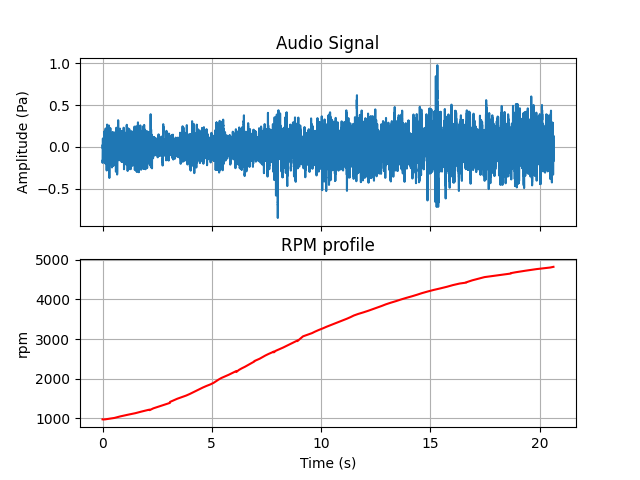
Load a signal from a WAV file using the LoadWav class.
This class contains two channels:
The actual signal (an acceleration recording)
The associated RPM profile
# Return the input data of the example file.
path_accel_wav = download_accel_with_rpm_wav()

# Load the WAV file.
wav_loader = LoadWav(path_accel_wav)
wav_loader.process()

# Extract the audio signal and the RPM profile.
signal, rpm_profile = wav_loader.get_output()
fs = wav_loader.get_sampling_frequency()

# Extract time support associated with the signal.
time = signal.time_freq_support.time_frequencies

# Plot the signal and its associated RPM profile.
fig, ax = plt.subplots(nrows=2, sharex=True)
ax[0].plot(time.data, signal.data)
ax[0].set_title("Audio Signal")
ax[0].set_ylabel(f"Amplitude ({signal.unit})")
ax[0].grid(True)
ax[1].plot(time.data, rpm_profile.data, color="red")
ax[1].set_title("RPM profile")
ax[1].set_ylabel(f"RPM")
ax[1].grid(True)
plt.xlabel(f"Time ({time.unit})")
plt.show()
Plot spectrogram of the original signal#
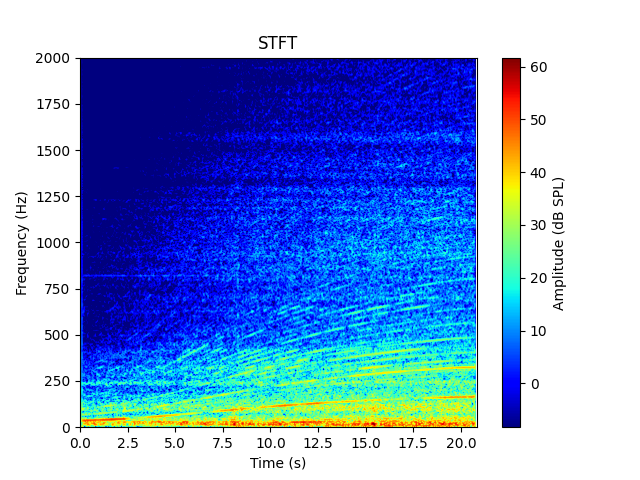
Plot the spectrogram of the original signal.
stft = Stft(signal=signal, window_overlap=0.9, fft_size=8192)
stft.process()
max_stft_dBSPL = 20 * np.log10(np.max(stft.get_magnitude()) / REFERENCE_ACOUSTIC_PRESSURE_IN_AIR)
max_frequency_Hz = 2000.0
stft.plot_custom(
    display_phase=False,
    reference_value=REFERENCE_ACOUSTIC_PRESSURE_IN_AIR,
    max_magnitude=max_stft_dBSPL,
    max_frequency=max_frequency_Hz,
)
Isolate orders#
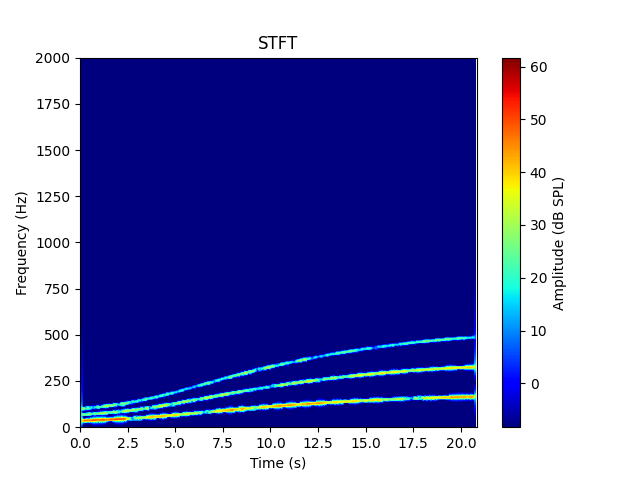
Isolate orders 2, 4, and 6 with the IsolateOrders class.
rpm_profile = wav_loader.get_output()[1]

# Define parameters for order isolation.
order_to_isolate = [2, 4, 6]  # Orders indexes to isolate as a list
fft_size = 8192  # FFT Size (in samples)
window_type = "HANN"  # Window type
window_overlap = 0.9  # Window overlap
width_selection = 3  # Width of the order selection in Hz

# Instantiate the :class:`.IsolateOrders` class with the parameters.
isolate_orders = IsolateOrders(
    signal=signal,
    rpm_profile=rpm_profile,
    orders=order_to_isolate,
    fft_size=fft_size,
    window_type=window_type,
    window_overlap=window_overlap,
    width_selection=width_selection,
)

# Isolate orders.
isolate_orders.process()

# Plot the spectrogram of the isolated orders.
stft.signal = isolate_orders.get_output()
stft.process()
stft.plot_custom(
    display_phase=False,
    reference_value=REFERENCE_ACOUSTIC_PRESSURE_IN_AIR,
    max_magnitude=max_stft_dBSPL,
    max_frequency=max_frequency_Hz,
)
Isolate different orders#
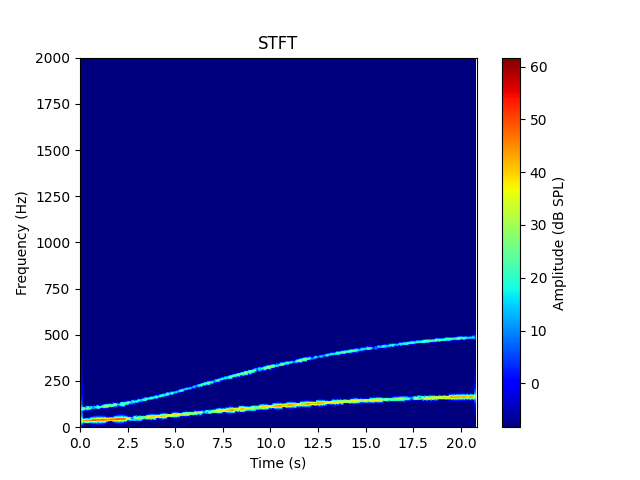
Change FFT size, order indexes, and window type. Then re-isolate the orders.
# Change some parameters directly using the setters of the class.
isolate_orders.orders = [2, 6]
isolate_orders.window_type = "BLACKMAN"

# Reprocess (Must be called explicitly. Otherwise, the output won't be updated).
isolate_orders.process()

# Plot the spectrogram of the isolated orders.
stft.signal = isolate_orders.get_output()
stft.process()
stft.plot_custom(
    display_phase=False,
    reference_value=REFERENCE_ACOUSTIC_PRESSURE_IN_AIR,
    max_magnitude=max_stft_dBSPL,
    max_frequency=max_frequency_Hz,
)
Work with the isolated signal#
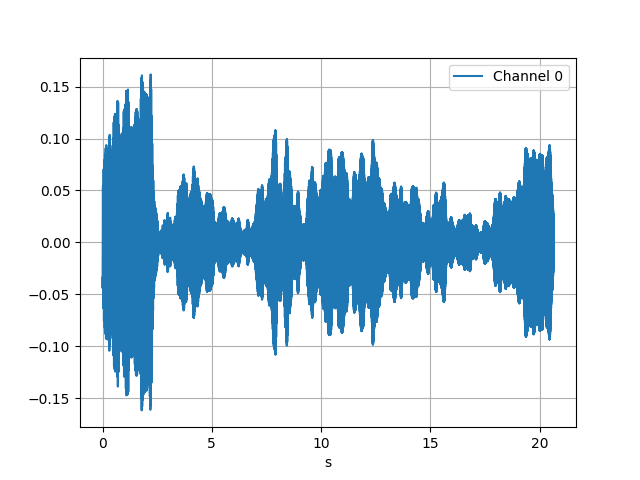
Plot the signal containing the isolated orders and compute its loudness.
# Plot the signal directly using the method from the :class:`.IsolateOrders` class.
isolate_orders.plot()

# Use the :class:`.LoudnessISO532_1_Stationary` class to compute the loudness of the order-isolated
# signal.
signal_isolated = isolate_orders.get_output()
signal_isolated.unit = "Pa"
loudness = LoudnessISO532_1_Stationary(signal=signal_isolated)
loudness.process()

loudness_level_isolated_signal = loudness.get_loudness_level_phon()

# Compute the loudness for the original signal.
loudness.signal = signal
loudness.process()

loudness_level_original_signal = loudness.get_loudness_level_phon()

print(f"The loudness level of the original signal is {loudness_level_original_signal:.1f} phons.")
print(f"The loudness level of the isolated signal is {loudness_level_isolated_signal:.1f} phons.")
The loudness level of the original signal is 76.6 phons.
The loudness level of the isolated signal is 61.4 phons.
Isolate orders of several signals in a loop#
Loop over a list of given signals and write them as a WAV file.
path_accel_wav_2 = download_accel_with_rpm_2_wav()
path_accel_wav_3 = download_accel_with_rpm_3_wav()
paths = (path_accel_wav, path_accel_wav_2, path_accel_wav_3)

fft_sizes = [256, 2048, 4096]

wav_writer = WriteWav()

# Isolate orders for all the files containing RPM profiles in this folder.
for file, fft_sz in zip(paths, fft_sizes):
    # Load the file.
    wav_loader.path_to_wav = file
    wav_loader.process()

    # Set parameters for order isolation.
    isolate_orders.signal = wav_loader.get_output()[0]
    isolate_orders.rpm_profile = wav_loader.get_output()[1]
    isolate_orders.fft_size = fft_sz
    isolate_orders.process()

    # Write as a WAV file.
    path_to_write = file[:-4] + "_isolated_fft_size_" + str(fft_sz) + ".wav"
    wav_writer.path_to_write = str(path_to_write)
    wav_writer.signal = isolate_orders.get_output()
    wav_writer.process()
Total running time of the script: (2 minutes 4.289 seconds)